Computational biology · Protein modeling

Felix Tuchscherer

Boston University - Double major in CS & Cell/Mol Bio '27

Hey! I'm Felix. Born in France, grew up in California, and now I study in Boston. I'm interested in the intersection between ML and biology. With all of our advancements in AI, I believe a lot of it can be used to unravel the arcana of biology. Cancer, aging, genetic disorders, and many more diseases will likely see treatments or cures within the next few decades. I yearn to be at that forefront.

Experience, mapped.

Explore the structure, then follow a site to the corresponding experience.
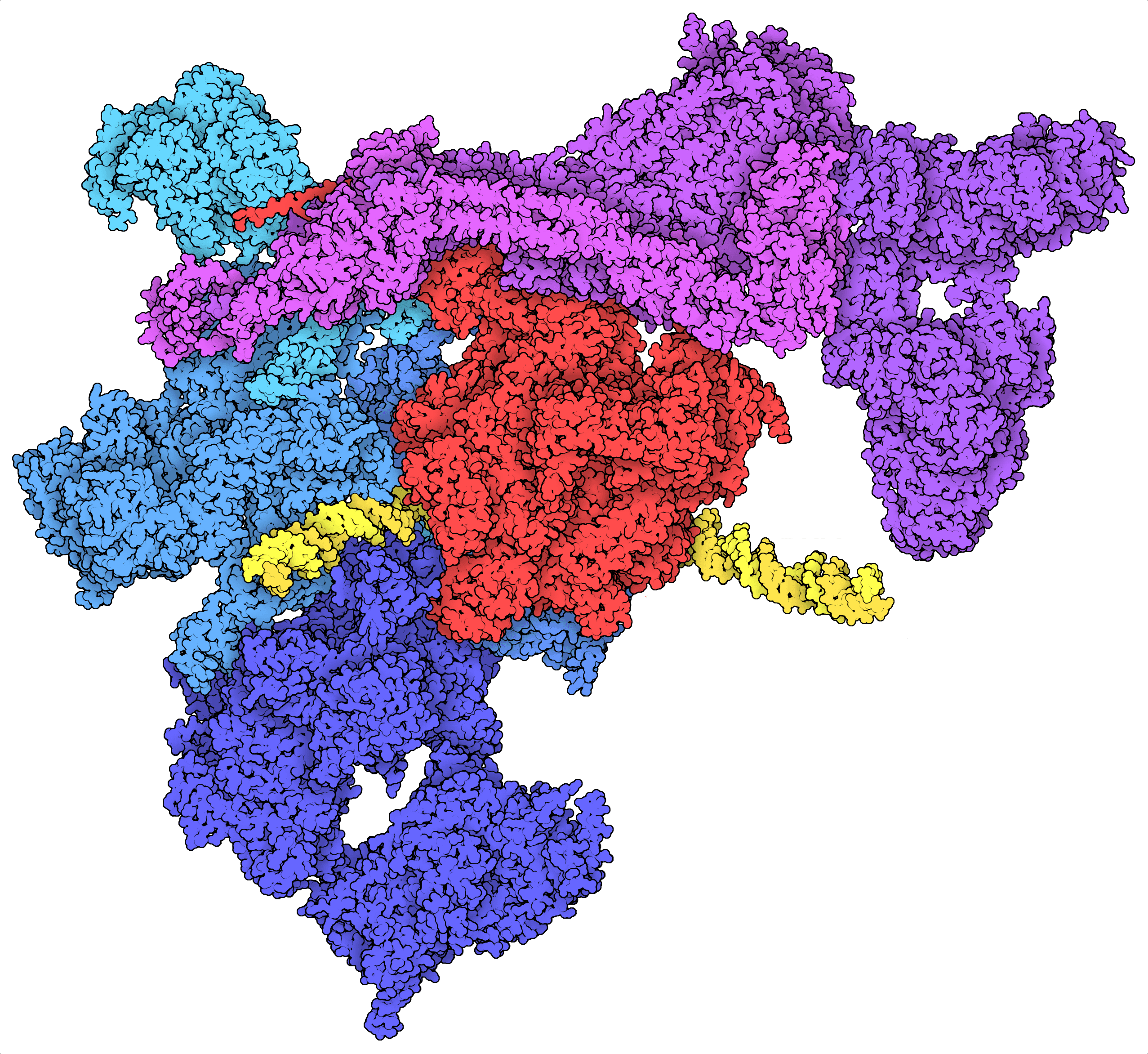
Molecular structure illustration used as an interactive map of Felix Tuchscherer’s experience
Molecule of the Month © David S. Goodsell and RCSB PDB, licensed under CC-BY-4.0This very cool protein complex is called the Mediator and is necessary for passing along the signal that tells a gene 'start now!' so the cell can build the protein it needs through transcription.

Boston, MA

Nov 2024 – Present

AlphaFold3 Cryptic Pocket Prediction

Nov 2024 – Jan 2026

  • Co-first-authored a paper investigating whether AlphaFold3 (AF3) protein-ligand co-folding can reproduce the conformational ensembles required for cryptic pocket formation – showing that ensemble-level sampling, not single top-ranked models, is necessary to reliably recover physically valid binding modes
  • Ran multi-seed AF3 structure predictions (100 seeds, 500 models/protein) across a 16-protein CryptoSite/CryptoBench benchmark, with and without ligand present, and built Python pipelines (Biopython, NumPy, BioPandas, Polars) to programmatically classify >24,000 predicted and PDB-deposited structures into open/closed conformational states via RMSD clustering – enabling benchmarking of AF3 against experimental bound/unbound distributions and quantifying its bias toward memorized structural priors ("detrimental memorization")
  • Designed an RDKit SMARTS-based ligand-pose scoring script that resolves atom-symmetry ambiguities in small-molecule alignment, correcting 12.5% of mismapped poses and enabling ligand-pose classification (≤2 Å RMSD) across thousands of co-folded predictions; used this to show ligand pLDDT correlates with pose accuracy (R² = 0.35), a finding relevant to confidence-based filtering in AI-driven drug design

RSV Antibody Classifier Generalization

Jan 2026 – Present

  • Leading project investigating why protein language model classifiers (ESM-2/ESM-C) trained to predict antibody-RSV binding fail to generalize beyond their training distribution; benchmarking nine model variants across three independent antibody datasets revealed recall on 720 confirmed binders falling to 52%, while retraining on combined original and external data recovered recall to 90%
  • Characterizing the biological basis of this distribution shift by comparing IGHV/IGLV usage, VH/VL germline pairings, CDR lengths and sequence composition, and clonotype/lineage structure; analyzing original and mixed-model embeddings with UMAP to relate dataset origin to classifier errors, and using AlphaFold3 to map predicted RSV F epitopes and test whether binding-site preferences contribute to generalization failure

New York City, NY

Jun 2026 – Aug 2026

  • Investigated whether graph-based (Neo4j) or relational (SQL) representations of clinical trial data better support reasoning by internally developed AI agents as datasets scale across dozens of interlinked tables, holding the LLM and reasoning loop constant and benchmarking both on free-text queries and structured data-review tasks
  • Evaluated both agents on a complex data consistency check: reconciling patient safety records against treatment-dosing records using time-window logic and cross-referenced fields spread across multiple tables – discovering that the graph agent caught relational dependencies more reliably (70% vs. 60% acc.)
  • Benchmarked agent reasoning efficiency on natural-language clinical data questions, finding the graph agent reached correct answers with 40% fewer tool calls on average than the SQL agent, while both achieved 100% correctness and consistency
  • Co-developed a self-managed authentication layer (PostgreSQL user store, bcrypt-hashed credentials, app specific authorization) enabling secure stakeholder access to an internal proof-of-concept handling sensitive clinical trial data and unblocking a previously stalled proof-of-concept due to insufficient security controls

Product engineering

Basil – AI Dietary Safety Startup

Chief Technology Officer

Boston, MA

Feb 2025 – Present

  • Sole engineer on a four-person team; architected and shipped a full-stack Next.js/TypeScript/Supabase platform piloted with Xenia Greek Hospitality, winning $15,000 at Boston University's 2026 Hospitality Innovation Competition
  • Designed an LLM pipeline that parses free-text dietary restrictions into schema-validated preferences via the OpenAI API, then deterministically classifies 40+ pilot dishes by allergen, diet, removable ingredients, and cross-contact risk
  • Built a hierarchical PostgreSQL ingredient knowledge graph from the Open Food Facts taxonomy, modeling parent-child relationships and computing ancestry to infer conflicts across dietary restriction categories
  • Hardened a privacy-preserving personalization layer with high-entropy QR tokens, HMAC-signed sessions, row-level security, and fail-closed validation; built a restaurant analytics dashboard to show trends and usage patterns

Boston, MA

Sep 2023 – Nov 2024

  • Designed an 8-condition phi29 rolling-circle amplification experiment varying primer concentration and SSB presence to reduce branching and overpriming, validated via gel electrophoresis and Qubit before Nanopore sequencing
  • Built a GPU-accelerated Nanopore processing pipeline using Dorado and an HPC cluster to convert raw sequencing signal into basecalled and aligned reads; identified a ~2.5% reference-mapping rate across all 8 conditions due to substantial off-target RCA products through SAM/BAM inspection
  • Developed a Python pipeline (pandas, NumPy, Matplotlib, Seaborn) to demultiplex reads by condition and compare read-length and AT/GC content distributions across RCA conditions to evaluate amplification quality

Microbial ecology

UC Davis Young Scholars Program

Research Assistant

Davis, CA

Jun 2022 – Aug 2022

  • Isolated and cultured bacterial strains across 4 media strengths, classifying microbes by life-history strategy and enabling downstream qPCR copy-number analysis of 16 isolates
  • Analyzed wood-chipped soil microbiome sequencing data in R to quantify alpha/beta diversity and rRNA copy number, identifying enhanced functional diversity and carbon-use efficiency compared to unamended soil
Headshot of Felix Tuchscherer

Driven to build tools that make biology more understandable

In my free time, I have been training Brazilian Jiu-Jitsu for almost 2 years. I also love reading fiction, anything from Brandon Sanderson's Stormlight Archives to Fyodor Dostoevsky's Crime and Punishment. I love traveling and eating and something I have recently gotten into is running! I spontaneously decided to sign up for the Cambridge half-marathon and have been running twice a week for about 2 months now! Life is ephemeral, and I hope to appreciate it as much as possible.

Projects

Admittedly, I can't say I've built only professional projects, but through each one I've followed an interest and truly learned new skills.

Molecule of the Month © David S. Goodsell and RCSB PDB, licensed under CC-BY-4.0

  1. Generative AI · Diffusion Model

    Handgen

    Are you tired of copying your digital notes out by hand? Well, I’m not, but nonetheless, my friend and I built Handgen: a local-first system that turns digital text into handwritten documents in your own style.

    At its core is DiffBrush, a diffusion-based deep learning model that generates handwritten prose using a writer’s handwriting samples as style references. We use DDIM sampling to synthesize handwriting, then verify the generated text against the source with OCR before composing the document. For mathematical notation, the pipeline combines generated digit components with a worksheet-derived glyph bank, normalizes ink weight and symbol spacing, and composes SVG documents with PNG exports.

  2. Machine learning · Healthcare

    MedAI Hackathon

    A hackathon research project that predicts acute tubular injury from plasma proteomics and clinical covariates in the Boston Kidney Biopsy Cohort. It compares feature-selection pipelines, gradient-boosted trees, regularized linear models, TabPFN, and probability ensembles through reproducible cross-validation.
  3. Automation · API Integration

    DailyViral

    Want to make some passive income? If so, you’ve come to the right place ;) While scrolling on Instagram, I’ve come across accounts that post the same funny video every day and rack up millions of views. I think this account is the most successful one I’ve seen. They literally sell merch!

    Inspired by this, I automated an account to post this video daily. I created a Python pipeline that rotates through captions, renders video overlays with FFmpeg, and publishes through Meta’s API. It supports local queued scheduling as well as deployment through GitHub Actions, backed by private Cloudflare R2 storage. You can check out my funny video on my account!

  4. Machine learning · Computational biology

    FoldIt 2.0

    BostonHacks was my first hackathon, and I decided to tackle a puzzle nature solves every day: protein folding. I built FoldIt 2.0 solo, reimagining Foldit as an interactive 3D puzzle where you twist and turn a protein to help it find its shape. Adjust torsion angles, watch your biophysical score change in real time, and get a nudge from machine-learning models toward more realistic structures. Think molecular origami, with a little help from ML.

  5. Client work · Web development

    CaroTouch Website

    I built this bilingual website for my aunt's massage therapy practice in Montréal. It presents her approach and services, answers common client questions, and directs clients to book via phone call.